- cstanescu7@gmail.com
- 970-389-2501
- Opening Time : 8AM - 5PM | Mon-Fri
Application Temperatures

Technical Tip
Most of our labels list the recommended temperature range for the application of the product, but there are always situations when you may need to know a bit more detail about application temperatures in order to schedule or complete a job. In some cases there are steps that can be taken to help cope with extreme hot or cold temperatures. Just remember that we are concerned with surface temperatures, not air temperatures. It is the temperature of the logs that must be considered, not the temperature on the thermometer hanging on the porch.
Finish Removers
| Product | Recommended Range for Best Results |
|---|---|
| StripIt® | 40° F – 90° F |
| S-100 | 50° F – 90° F |
Finish removers become less effective as the temperature decreases. In other words, the colder it is the longer they take to work. It’s not that these products can’t be used in cold temperatures; it may just take several more hours of contact time (slower rate) to soften an existing finish enough to remove it. One positive note about both S-100™ and StripIt® is that prolonged contact with the surface will not damage the wood fibers. At high temperatures the challenge is preventing either product from drying out. This can be accomplished by keeping the surface damp.
Lightly mist S-100™ with water or apply additional StripIt® to the coated surface (Note: Do Not mist StripIt® with water.). Furthermore, press a sheet of plastic (6 mil) against S-100™ or StripIt® to slow down the evaporation rate to help it from drying out. If S-100™ or StripIt® dries on the surface, they are no longer active. To remove the dried residue of S-100™ or StripIt® from the wood surface, apply an additional application of the respective material to re-wet the dried material and pressure wash off. As long as they are kept moist (Water for S-100™ and apply additional material for StripIt®, no water) in hot weather, these products don’t take very long to do their job.
Cleaners & Brighteners
| Product | Recommended Range |
|---|---|
| Log Wash™ | 40° F – 90° F (not stated on label) |
| Wood ReNew™ | 50° F – 90° F (not stated on label) |
| Oxcon™ | 50° F – 90° F (not stated on label) |
Somewhat like finish removers, cleaners and brighteners work better at warm temperatures than cold ones. Of the three products listed above Log Wash™ is the least affected by cold temperatures. A wash down with Log Wash even at temperatures close to freezing will still do some good. On the other hand at very cold temperatures applications of Wood ReNew™ and Oxcon™ may not be very effective even if kept on the wall for several hours. That’s because they rely on chemical reactions to accomplish their tasks and reaction rates significantly decrease as the surface temperature approaches 32° F. If any of these products are allowed to dry, they stop working so in hot weather they too need to be kept wet with an occasional light mist of water. It is especially important to keep Oxcon™ wet since if it’s allowed to dry on a wall crystals of oxalic acid will form in the top layer of wood and once formed they are quite difficult to rinse off. Even a minor amount of oxalic acid residue can severely reduce adhesion of a finish.
LIFELINE™ Exterior Finishes
| Product | Recommended Range |
|---|---|
| All Lifeline™ stains | 40° F – 90°F |
| Lifeline™ Advance | 40° F – 90°F |
| Log End Seal™ | 40° F – 90°F (not stated on label) |
What happens in early spring and late fall if the temperature falls below freezing a few hours after the finish is applied? As far as we know freezing conditions encountered after application and film formation has no effect on the look or performance of the finish. The surface temperature limitations pertain to the temperature of the walls while staining, not to temperatures that the walls may be exposed to after staining. Any of our LIFELINE™ stains can probably be applied down to a wall temperature of about 35° F if necessary, but remaining at 40oF or above is best. The main problem at those temperatures is that it will take a long time, perhaps days, for a coat to dry enough to apply a second coat (Lifeline™ Exterior or Ultra-2) or Advance Topcoat.
If applied too soon, the film will ball up into little beads during back-brushing. The one thing you never want to do is attempt to stain logs that are frozen. The finish may not adhere to the wood. At high temperatures drying time is also an issue but in this case the film may dry so quickly that it won’t be able to be back-brushed. Advance applied at cold temperatures presents a somewhat different challenge in that the longer it stays uncured, the more susceptible it is to blushing. At high temperatures the fast drying time may prevent adequate back-brushing. Although the surface temperature range on the labels of our finishes is between 40°F and 90°F, the most favorable temperatures for easiest application is between 50°F and 80°F.
The finish most sensitive to cold weather application is Log End Seal™. Log End Seal™ is somewhat water sensitive before it completely cures and since cold weather retards the curing time, there is a good chance that the Log End Seal™ may blush white and stay that way for several months, especially on thicker applications. Given some warm dry weather it will eventually become clear and stay that way. It is recommended to coat Log End Seal™ with Lifeline™ Advance Gloss or Satin to protect it from blushing and dirt pick-up.
Sealants
| Product | Recommended Range |
|---|---|
| Perma-Chink® | Above 40°F |
| Energy Seal™ | Above 40°F |
| Woodsman™ | 40° F – 120°F |
| Check Mate 2® | 40° F – 90°F (not stated on label) |
When applying any of our sealants in cold weather there are two main factors to consider, the temperature of the logs and the temperature of the product. As long as the logs are dry and not frozen, any of our sealants can be applied to them without comprising appearance or performance. The problem associated with very cold sealants is viscosity, their viscosity increases as the temperature decreases. In other words, they become thicker. This is especially apparent when trying to squeeze product out of an 11 ounce or 30 ounce tube or when attempting to load a bulk loading gun from a pail of sealant.
Cold product is also more difficult to tool. It’s always best to store our sealants in a controlled environment (50-70oF), they will be a lot easier to apply and tool. Once applied the only effect that freezing temperatures have on our sealants is lengthening the time it takes for them to cure. Whereas in summer months it may take Energy Seal™ or Perma-Chink® a matter of a few weeks to completely cure, during the winter it may take a couple of months to complete the curing process. No matter what the time of year it is advisable to never apply a sealant in direct sunlight. Even if the day is cool, direct sunlight can cause the surface to skin over before the remaining free water has a chance to evaporate resulting in blisters forming on the surface of the sealant.
In very hot weather blistering can occur if the sun rapidly heats the wall after chinking has been applied, especially if the underlying wood is green or damp. Draping the chinked wall with a tarp until the chinking cures will help prevent the formation of blisters. Another challenge using our sealants in very hot weather is that the surface may dry so quickly that tooling time may be reduced to only a few minutes. If masking tape has been used to protect the surrounding outer surfaces, it’s imperative to remove it before the surface starts to dry. If left on too long, it will pull off the skinned-over layer of sealant along with it. Although we don’t specifically state an upper limit on the Perma-Chink and Energy Seal labels, we discourage either product’s use above 90°F. Note: The upper end of the Woodsman™ application temperature range is 120°F. That’s fine if the Woodsman is to be used between courses of logs but if it is going to be used as an external sealant in a manner similar to Energy Seal, 90°F should be considered its upper temperature limit.
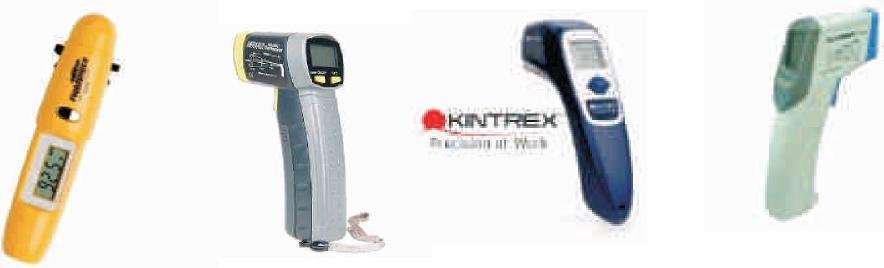
The Tool Every Contractor / Applicator Should Have These days there is no reason for any professional to profess ignorance about the surface temperature of a wall prior to the application of any of our products. Infrared thermometers used to be quite expensive but a quick search on Amazon.com resulted in a number of them that cost between $25 and $50. At that price they are affordable to anyone including a homeowner who wants to eliminate the guesswork of determining if a wall is too hot or too cold before applying a finish or sealant. Some Inexpensive Infrared Thermometers